Day 14 Saturday 11th Jan

 The Tower of London was built in the 1070 -1080s by William the Conqueror using some of the south eastern wall foundations of the previous
Queens' Lady Jane
Grey and Anne Boylen and Catherine Howard were imprisoned and executed in the Tower complex but most
prisoners (~125) were publicly beheaded on Tower Hill nearby including Thomas
More, and John Fisher.
 The Chapel
in the complex contains the tombs of 3 Queens of Henry VIII: Catherine Howard, Anne Boylen, and
Lady Jane Grey. Out the side are the
tombs of Saints Thomas Moore and John Fisher.
Due to the kindness of one of the Tower Yeomen's Warders and some fast talking
from Maureen about working in a school
called Thomas Moore College, we were able to get a couple of minutes in prayer
at the Tomb of Saint Thomas Moore. This
was extremely moving for both of us and , all the more so, given the tomb is
normally only allowed to be visited after special permission. As a giant of faith and conscience Thomas
Moore is a man we can only admire and see as a exemplar.
The Chapel
in the complex contains the tombs of 3 Queens of Henry VIII: Catherine Howard, Anne Boylen, and
Lady Jane Grey. Out the side are the
tombs of Saints Thomas Moore and John Fisher.
Due to the kindness of one of the Tower Yeomen's Warders and some fast talking
from Maureen about working in a school
called Thomas Moore College, we were able to get a couple of minutes in prayer
at the Tomb of Saint Thomas Moore. This
was extremely moving for both of us and , all the more so, given the tomb is
normally only allowed to be visited after special permission. As a giant of faith and conscience Thomas
Moore is a man we can only admire and see as a exemplar.
On reflection I was
perturbed that the tomb of such a prominent
Catholic Saint is so inaccessible to pilgrims and visitors to this site
and I wonder why the tomb has not been moved.
There is no focus on the life of Thomas Moore at the Tower and this is
unfortunate but perhaps not surprising given the religious tensions that it may
invoke.
The dazzling Crown
Jewels were on display but I did not realise that the original jewels (crowns,
orbs, sceptres) were melted down after the execution of Charles I in 1649 and after
Oliver Cromwell was defeated and the royalty reinstated in 1660 a new set was
made.
 An unexpected fact about the Tower
is that it contained a zoo housing African animals including lions and monkeys
from the 13th -19th century. The animals were moved to the London Zoo when
it opened.
An unexpected fact about the Tower
is that it contained a zoo housing African animals including lions and monkeys
from the 13th -19th century. The animals were moved to the London Zoo when
it opened.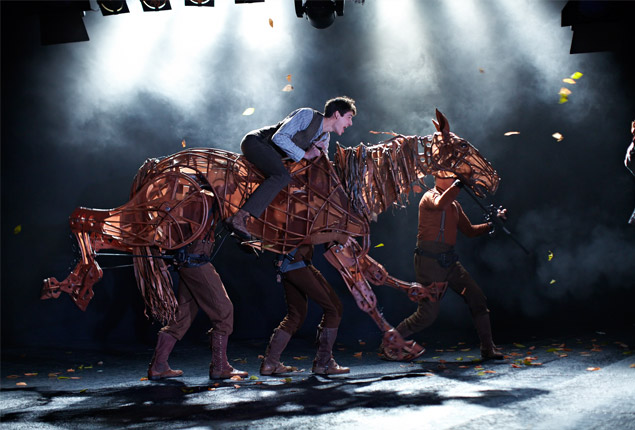
In the
evening Maureen’s cousin Sally had booked us tickets to a play called “WarHorse’ (based on the novel , there is also a movie by Stephen Spielberg) at the
New Theatre in the West End. We got off
the tube at Covent Gardens and walked through Trafalgar Square and up through Soho to get to the Theatre. It was a very vibrant and busy locale for a
cool Saturday evening.
The Play has had rave reviews and rightly so.
It was mesmerizing as life size puppets of the central characters were skilfully
manipulated around the stage. The plot
involves a horse raised on a farm by a young boy that is later sold by the
boy’s father to the English Calvary and becomes a war horse in France. The young man joins the army to try to find
his horse. It is a poignant story of
friendship, loyalty heartbreak and the tragedy of war. Watching this Play reminded me of happy times with my childhood pony ‘Curly’
whom I rode from about 8 -12 years of age.

No comments:
Post a Comment